| Most viewed - Religion |
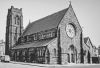
St Michael's Church955 viewsHelensburgh's St Michael and All Angels Scottish Episcopal Church stands at the corner of William Street and West Princes Street. On Sunday August 22 1841 a congregation of Scottish Episcopalians met in the room of a house in William Street, where Divine Service was solemnised by the Very Rev William Routledge. Their first church, dedicated to the Holy Trinity, opened on the site of the present St Michael's Church in 1843. Sir Robert Rowand Anderson, a prolific architect and pupil of George Gilbert Scott, chose the style of the Gothic Revival for the current church which was consecrated on May 7 1868. it is Helensburgh's only grade A listed church. Photo by Professor John Hume.
|
|
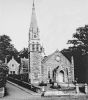
Shandon Church948 viewsBuilt in 1844 as Shandon Free Church, it became linked with Rhu Church in 1954. It continued in use until 1981 and was then converted into housing, with the height of the steeple being substantially reduced. Shandon Pier used to stand straight across the road from the church. Photo by Professor John Hume.
|
|
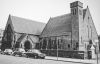
United Reformed Church941 viewsThis building occupies the site of Helensburgh's very first church, The Tabernacle, which was built in 1802 at the corner of James Street and West Princes Street. Almost immediately after the building was opened the congregation voted to become part of the Congregational Church. The original building had to be demolished in 1851 and a new church was built on the site which now serves as the church hall, and which can be seen on the right side of the photo. Today's church (on the left of the photo) was built in 1884. In 2000 the Congregational Church joined the United Reformed Church. Photo by Professor John Hume.
|
|
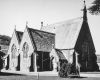
St Modan's Rosneath938 viewsSt Modan came to Rosneath around the year 600 and founded probably one of the oldest churches in Scotland. He died around the year 700 and a gravestone preserved in the present church is probably his. Today's church, an A listed building, is the fifth, and it was opened for worship in 1853 and subsequently extended twice. Two items in the building, a Bible and the reredos, are linked to Princess Louise, daughter of Queen Victoria and wife of the 9th Duke of Argyll, who lived in Rosneath Castle.Photo by Professor John Hume.
|
|
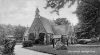
St Modan's Church918 viewsA 1905 image of Rosneath Parish Church, St Modan's.
|
|
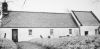
St Mahew's909 viewsThe origins of this chapel are lost in the mists of time but gravestones there have been dated to the 9th or 10th century. The earliest surviving documents which speak of a chapel at Kilmahew come from the reign of King David II (1329-70). Following the Reformation in 1560 the chapel became derelict, but from 1640 until 1846 part of it was used as the village school. In 1948 it was acquired, as part of the Kilmahew Estate, by the Roman Catholic Archdiocese of Glasgow. Five years later work on restoration started and it began to serve again as a chapel in 1955. Today it is believed to be perhaps the oldest place of worship in the west of Scotland still being used for its original purpose. Photo by Professor John Hume.
|
|
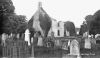
Rosneath Old Parish Church909 viewsSt Modan's Old Parish Church, Rosneath, stands near to its successor, and is surrounded by a graveyard. The church is now a roofless ruin, with some of the walls still standing. This site is said to have had a church for centuries, with this ruined church being the fourth church on the site. There are records of ministers stretching back to 1250. The site was apparently established by St Modan, who may be buried at Faslane. The image is from a 1908 postcard, kindly supplied by the Helensburgh Memories Facebook page.
|
|
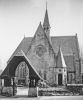
Luss Church908 viewsIt is believed that St Kessog (or MacKessog) founded a church in Luss in the year 510, and it was in the name of Kessog that King Robert the Bruce went into battle against the English at Bannockburn in 1314. However the present building was opened in 1875 to commemorate the deaths of Sir James Colquhoun and a group of his gamekeepers in a boating accident in Loch Lomond two years earlier — indeed from inside the roof looks like an upturned boat. Some of the graves in the churchyard go back to the 7th or 8th century, and there is also a Viking hogback stone. Photo by Professor John Hume.
|
|
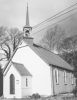
Peaton Church895 viewsThis small corrugated iron church was affectionately known as "The Tin Hut Church". It is not known when this church opened, but it was certainly in existence before 1893. It was generally only used for a short time in summer, principally to cater for visitors to the area. It stood by the shore road between Cove and Coulport and was used until 2002, being finally demolished eleven years later. Photo by Professor John Hume.
|
|
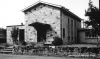
Church of Christ, Scientist882 viewsHelensburgh's Church of Christ, Scientist, in West Princes Street, was designed in 1956 by Margaret Brodie. The First Church of Christ, Scientist had its beginnings in Helensburgh in 1910, and a plot of ground at 138-144 West Princes Street was bought in 1946; ten years later a church was built there. By 2015 the building was closed and for sale, and it was bought by a firm of architects who announced two2 years later that they would convert it into flats. Photo by Professor John Hume.
|
|
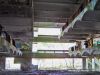
2009 St Peter's878 viewsThe interior of the derelict St Peter's Seminary at Cardross — now the centre of a restoration project — pictured in 2009 by Stewart Noble.
|
|
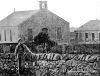
Cardross Free Church872 viewsThe original Free Church of Scotland in Cardross. Today there is a house called 'Kirklands' at the south side of Main Road just to the west of its junction with Bainfield Road, and the church was on the site of what is now the garage of that house. The present church building on Station Road was built in 1872 and served as the Free Church of Scotland until 1929 when the Church of Scotland and the Free Church were united. As there were now two C of S congregations the former Free Church was given the name 'Burns Church'. This was the case until after World War Two when the two congregations were united to form Cardross Parish Church in the present building.
|
|
|
|